How to Judge Clearance Distance When Passing Parked Cars and Obstacles
One of the most common challenges for learner drivers is knowing whether there is enough room to pass a parked car, cyclist, roadworks or another obstacle safely.
It can be difficult at first because you are trying to judge the position of your car from inside the driver’s seat. The good news is that you don’t have to guess.
At Fast Pass Driving School, we teach learners to use reference points to help judge clearance and make passing obstacles much easier.
Look ahead and plan early
When you see a parked vehicle or obstacle ahead, don’t wait until you are right next to it before deciding what to do.
Start looking ahead early and ask yourself:
“Have I got enough room to get past safely?”
Look at the road ahead, check for oncoming traffic and consider whether the road is wide enough for you to pass without getting too close to the parked vehicle.
Remember, you are responsible for making sure there is enough space before you commit to passing.
Use your reference points
A useful way to judge clearance is to use reference points that you can see through your windows and windscreen.
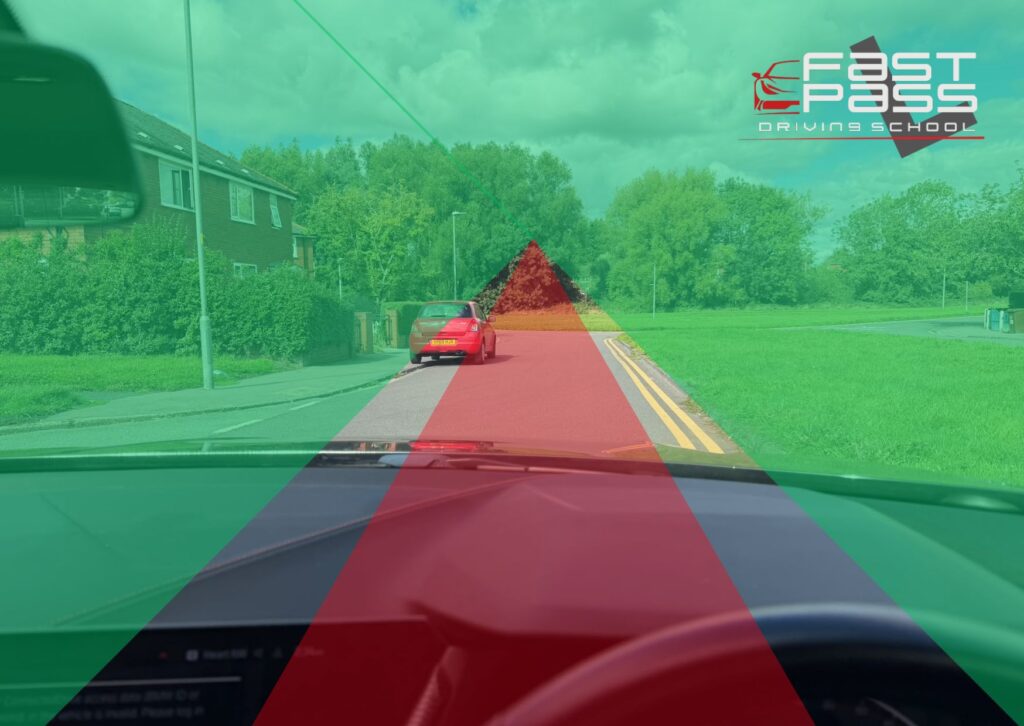
The image above shows how we can think about the space around the car.
 Red area – Not enough room
 Red area – Not enough room
If the obstacle appears within the red area, this means there isn’t enough room for your car to pass safely.
Don’t try to squeeze through.
You may need to slow down, stop and wait for the obstruction or for another vehicle to pass.
Unshaded area – Room to work with
 Unshaded area – Room to work with
The unshaded area represents space that you have available to work with.
If the obstacle is in this area, you may have enough room to pass, but you still need to consider:
- The width of your car
- The width of the road
- Oncoming traffic
- Pedestrians and cyclists
- Your speed
- Whether the road is clear beyond the obstacle
Don’t rely on the colour alone. Always keep checking what is actually happening around you.
Green area – Safe space
 Green area – Safe space
The green area represents the space where you have good clearance from the obstacle.
If you can see the obstacle sitting within the green area, you have more room to pass.
However, remember that green does not mean “automatically safe.” You still need to check mirrors, blind spots, oncoming traffic and anything else that could affect your manoeuvre.
Don’t stare at the obstacle
A common mistake learners make is looking directly at the parked car as they drive past it.
This can make you steer towards it.
Instead, once you have checked your clearance, look further ahead along the road and keep your steering smooth.
Your car will naturally tend to go where you are looking.
Slow down if you’re unsure
If you’re not sure whether you have enough room, slow down.
There is no prize for getting through a gap quickly.
Reducing your speed gives you more time to:
- Assess the gap
- Check for oncoming vehicles
- Adjust your position
- Stop if necessary
If the gap is too small, wait. It’s much better to wait for a safe opportunity than to try and force your way through.
Remember: your reference points are personal to your car
One important thing to understand is that reference points can be different in different cars.
Your seating position, the size of the vehicle and the shape of the bonnet can all affect what you see.
This is why your driving instructor can help you establish your own reference points for the car you are learning in.
Once you understand where those points are, judging clearance becomes much easier and more consistent.
A simple rule to remember
When approaching a parked vehicle or obstacle:
LOOK → PLAN → CHECK → SLOW DOWN → PASS
Don’t rush the decision.
Give yourself plenty of time to work out whether you have enough room, and if you don’t, wait.
With practice, judging clearance becomes much more natural. What feels difficult at the beginning will eventually become something you do almost automatically.
Learning to judge clearance?
 Learning to judge clearance?
At Fast Pass Driving School, we can help you build your confidence with positioning, clearance and passing parked vehicles safely.
Good observation + good planning + good reference points = safer driving.
Your Questions Answered:
Look ahead early and use reference points to judge where the parked car sits in relation to your vehicle. If you’re unsure, slow down and be prepared to stop.
Reference points are areas you can use to judge the position of your car. They help learner drivers understand how much space they have when passing parked cars, obstacles and other vehicles
You should leave a safe amount of clearance and avoid getting unnecessarily close to the parked vehicle. The amount of space available will depend on the road, your vehicle, oncoming traffic and other hazards.
Slow down and be prepared to stop. If an oncoming vehicle has priority or there isn’t enough safe space, wait until there is a suitable opportunity to continue.
Learners are still developing their understanding of the size and position of the car. Using suitable reference points and practising with a driving instructor can make judging clearance much easier and more consistent.
Get in touch. The best way to contact us is via WhatsApp, Email or give us a call.
What Our Customer Are Saying About Fast Pass Driving School
Posted on FacebookrecommendsTrustindex verifies that the original source of the review is Facebook. I genuinely cannot recommend Andras enough!! 😭👏 After all the stress, nerves and worrying about my driving test, Andras somehow managed to get me through it and I PASSED FIRST TIME!!! 🥹🚗💨 He is honestly such an amazing instructor. He was so patient, reassuring and encouraging, even when I was convinced I was going to completely mess everything up 😂. He explained everything so clearly, never made me feel stupid for asking questions, and always knew exactly what I needed to work on. There were definitely moments where I thought, “There is absolutely NO way I’m passing this test” 😭 — but Andras had more faith in me than I had in myself. He pushed me when I needed pushing, calmed me down when I was stressing, and prepared me so well for the actual test. And then… FIRST TIME PASS!!! 🥳🥳🥳 I honestly don’t think I could have done it without him. If you’re looking for a driving instructor who genuinely cares about getting you confident, safe and test-ready, go with Andras!! 1000000/10 ⭐️⭐️⭐️⭐️⭐️Posted on FacebookrecommendsTrustindex verifies that the original source of the review is Facebook. I never thought i would be capable of doing lessons let a loan passing my test. i Started 8 months ago an absolute nervous wreck, if it wasn't for andras i think i would have given up completely. He put confidence in me and made me realise i am more then capable of doing this. My motivation was my children and being able to have a car before the 6 weeks holiday is seriously gonna change my family's life forever. Thankyou so much for all your patience and persistence. xxPosted on FacebookrecommendsTrustindex verifies that the original source of the review is Facebook. Cant recommend Andras enough! He's patient and calm which is great for any nervous learner! What a sense of humour too! Thank you for the support and confidence!Posted on FacebookrecommendsTrustindex verifies that the original source of the review is Facebook. What can I say!! 5 stars just aren’t enough, 100 would be more accurate! I learned to drive with Andras, who is in my humble opinion the best driving instructor the world has to offer. He is so patient, understanding and supportive, he was firm when he needed to be, but in the best possible way! He quite honestly brings the best out in you! He sees your potential and nurtures it until you are ready believe in yourself! My driving journey wasn’t easy for me, I started with incredibly bad nerves, other driving instructors had shot my confidence into ground, I was terrified of roundabouts and I had such a negative outlook when I first started! But with Andras, we learned together, we adapted the lessons so that I felt as comfortable as I ever could…and today, on my birthday, I passed my driving test!! I can’t thank Andras with fast pass enough!!! I have a freedom now I never thought I’d have!! Thank you again, so so much, I’ll never forget our lessons and things I’ve learned on the way, I highly highly recommend Andras and fast pass driving school! 🌟🌟🌟🌟🌟Posted on FacebookrecommendsTrustindex verifies that the original source of the review is Facebook. Learnt to drive and pass in 3 months with Andras! Andras is absolutely faultless and helped me (a very nervous driver) to pass, so friendly and puts the learner at ease. Also very reliable, tailors his teaching to your needs and remains cool, calm and collected! Absolutely couldn’t recommend enough!! Plus if you pass with 5 or less minors he gets you an ice cream!Posted on FacebookrecommendsTrustindex verifies that the original source of the review is Facebook. couldn't recommend michelle enough!! she has been so amazing with my anxiety and adhd and she is so patient, she makes everything so clear and is always finding new ways to help🥰Posted on FacebookrecommendsTrustindex verifies that the original source of the review is Facebook. Starting my lessons in February with Andras, was a nervous wreck, Andras made me feel instantly calm and taught me the ability to believe in myself and give me the confidence to drive. Today I passed with zero minors and this all thanks to Andras believing in me and giving me the tools to pass and be a good safe, confident driver! I will miss driving with you THANK YOU SO MUCHPosted on FacebookrecommendsTrustindex verifies that the original source of the review is Facebook. andras is amazing, 2 months ago i never thought it would be possible to drive and in the first lesson he made me realise it was. he’s so calm , patience and filled me with so much confidence his support has been great, he’s is such a friendly guy and a great laugh, really recommend to anyone, i passed first time with 3 minors 🚘Posted on FacebookrecommendsTrustindex verifies that the original source of the review is Facebook. I cannot recommend Andras enough! As someone who has struggled finding a driving instructor non of them seemed to work for me. Just after one lesson i was so much more confident and comfortable driving because of how welcoming he is, I don’t think we stopped laughing I managed to pass first time with three minors which is something that felt absolutely impossible just a month ago I cannot recommend enough!Posted on FacebookrecommendsTrustindex verifies that the original source of the review is Facebook. I can’t recommend Michelle highly enough. I was a very anxious driver, and she completely transformed my confidence. I passed my test on the second attempt with only 4 minors — my first test I actually had just 2 minors but failed because my nerves got the better of me. Michelle supported me through that setback and helped me come back stronger. She’s an excellent teacher who really pushes you to learn, but always in a way that feels supportive and encouraging. Her understanding of driving is incredible, and she tailored her teaching style to suit me personally, which made such a difference. She’s calm, patient, and has a great personality that makes lessons enjoyable and stress-free. I can’t recommend Michelle enough. Excellent teacher.