Step-by-Step Guide to
Reverse Bay Parking
Learn our simple method for reverse bay parking and build the confidence to complete the manoeuvre safely on your driving test.
Reverse bay parking can seem tricky at first, but with the right technique and plenty of practice, it can become a simple and controlled manoeuvre. In this step-by-step guide to reverse bay parking, Fast Pass Driving School will show you how to reverse bay park during your driving test, using clear reference points and easy-to-follow instructions to help you position the car safely and accurately.
There are many different methods and techniques you can use to reverse bay park, and different driving instructors may teach the manoeuvre in slightly different ways. This is the method we find our learners can remember and master easily, giving you a simple routine to follow while still developing the observation, steering control and accuracy needed for your driving test. With regular practice, you can build your confidence and learn how to reverse safely into a bay under test conditions.
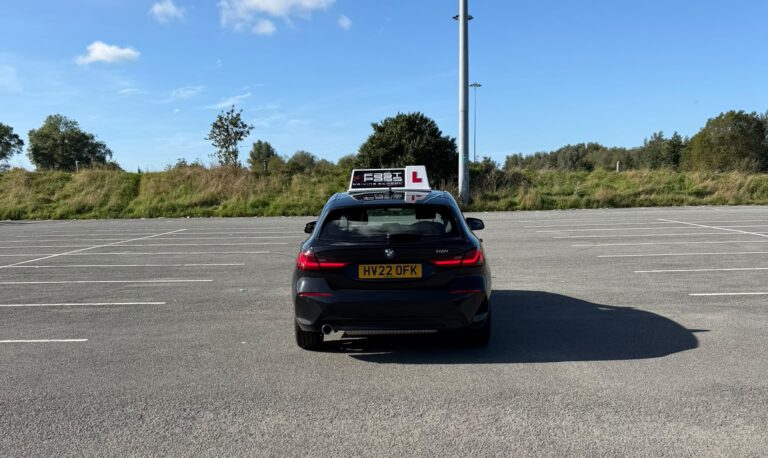
1. Line the vehicle up in the centre of the road
Before beginning the reverse bay park, position your vehicle so that it is roughly in the centre of the road or driving lane, giving yourself enough space to steer smoothly into your chosen bay. Make sure your speed is slow and controlled, and take effective all-round observations before starting the manoeuvre. On the UK driving test, you can choose a convenient parking bay, and the examiner is looking for safe control, observation and a final position within the bay.
2. Choose your bay and use your reference point
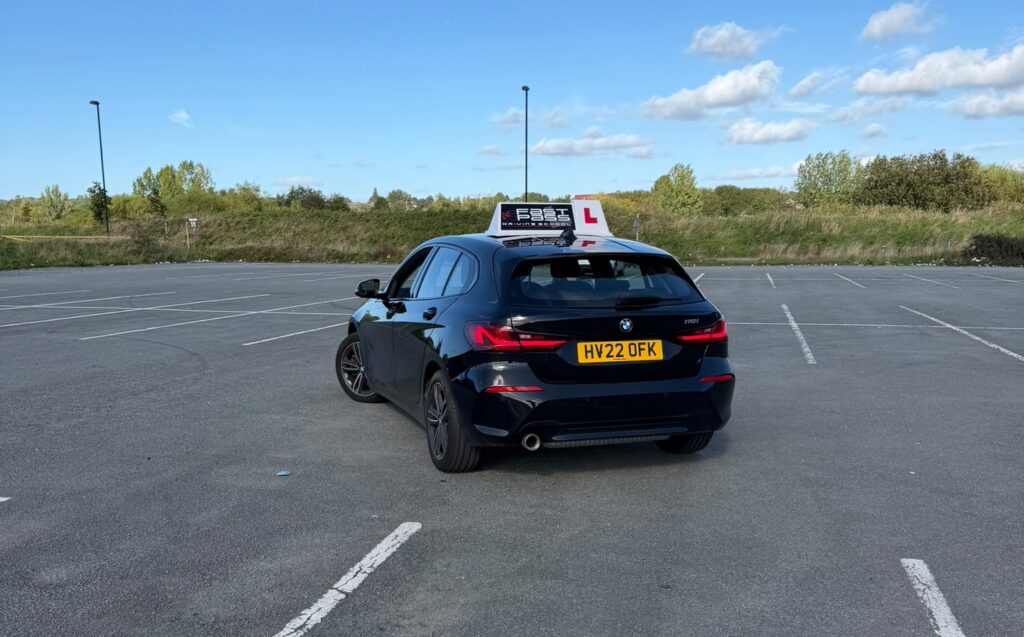
Once you have selected the bay you want to reverse into, identify the bay markings and count three further bay lines beyond your chosen space. Use these lines to help position the vehicle before you begin reversing. When the third line is level with your chosen reference point on the car, you’ll have a consistent starting position for the manoeuvre. Reference points can vary depending on the vehicle and the method taught by your instructor, so make sure you practise using the same reference point during your lessons to build confidence and consistency.
3. Turn the steering and begin reversing
Once you’re in the correct position, turn your steering wheel to full lock towards the bays you have chosen to reverse into. Before moving, take effective all-round observations, including checking your blind spots, mirrors and the area around the vehicle, making sure it is safe to proceed. When you’re satisfied it’s clear, select reverse and begin moving slowly and under full control, continuing to check your surroundings as you reverse.
4. Keep the steering on full lock
Continue reversing slowly while keeping the steering on full lock towards the bay. As the vehicle turns, keep checking your mirrors and surroundings so you can monitor your position and make sure it remains safe. If you have positioned the car correctly and used your reference point accurately, the vehicle should naturally follow the turn and finish straight within the bay. Remember, the reference point is a guide rather than a guarantee, so be prepared to make small adjustments if necessary.
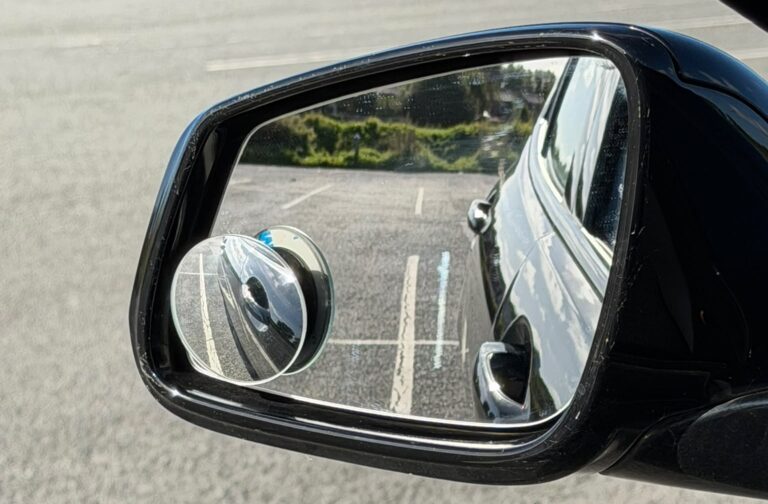
5. Straighten the steering and check your final position
As you continue reversing, keep checking your mirrors and surroundings to monitor your position in the bay. Once the vehicle is straight and aligned with the bay you are reversing into, straighten the steering wheel so your front wheels are pointing straight ahead. Continue reversing slowly and under control, making any small adjustments if needed to ensure the vehicle finishes neatly within the bay.
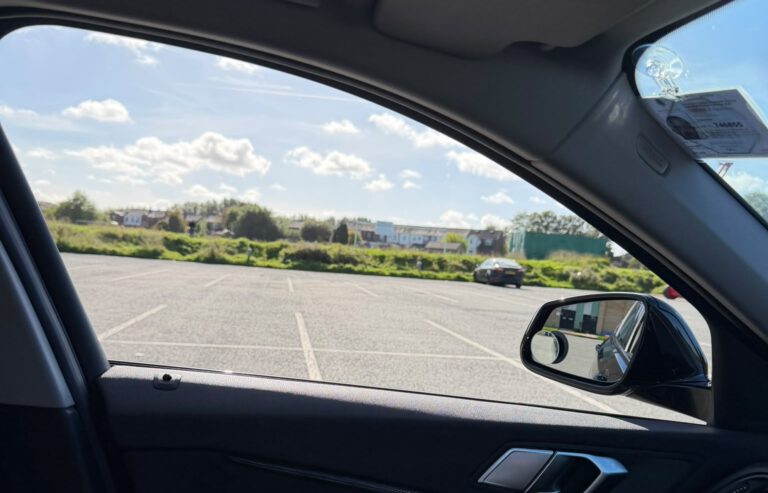
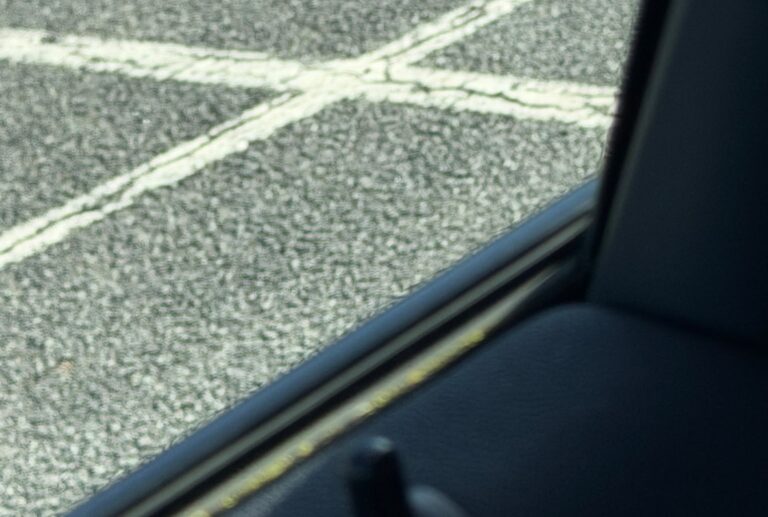
It’s important to make sure you don’t reverse over the line behind you or hit the kerb. Use an additional reference point to help you judge when to stop. For example, when looking out of the driver’s-side window, you should be able to see the line behind your vehicle, as pictured below. Use this reference point to help you stop in the correct position while maintaining good control of the car.
Frequently Asked Questions
Find answers to some of the most common questions about reverse bay parking on your driving test.
Yes. During the driving test, your examiner will ask you to reverse into a suitable bay. You can generally choose which bay you want to use, provided it is safe and suitable for the manoeuvre.
.
You don’t have to be absolutely perfect, but you need to demonstrate good control, observation and accuracy. If you need to make a small correction, you can do so as long as it is carried out safely and under control.
Reference points can help you judge when to start turning and when to stop. The correct reference point can vary depending on the vehicle you are driving, so your driving instructor can help you find reference points that work consistently in your car.
Touching the kerb can affect your driving test result, depending on how it happens and whether it creates a safety issue. Avoid mounting or hitting the kerb by reversing slowly, using your mirrors and making effective observations throughout the manoeuvre.
The best way to improve is through regular practice with a qualified driving instructor. Practise your positioning, reference points, steering control and observations until you can complete the manoeuvre safely and consistently without relying entirely on memorised steps.
If your looking for more driving test tips like this folow our blog or our social media pages, If you would like to book manual driving lessons or automatic driving lessons with us, get in touch.
What Our Customer Are Saying About Fast Pass Driving School
Posted on FacebookrecommendsTrustindex verifies that the original source of the review is Facebook. I genuinely cannot recommend Andras enough!! 😭👏 After all the stress, nerves and worrying about my driving test, Andras somehow managed to get me through it and I PASSED FIRST TIME!!! 🥹🚗💨 He is honestly such an amazing instructor. He was so patient, reassuring and encouraging, even when I was convinced I was going to completely mess everything up 😂. He explained everything so clearly, never made me feel stupid for asking questions, and always knew exactly what I needed to work on. There were definitely moments where I thought, “There is absolutely NO way I’m passing this test” 😭 — but Andras had more faith in me than I had in myself. He pushed me when I needed pushing, calmed me down when I was stressing, and prepared me so well for the actual test. And then… FIRST TIME PASS!!! 🥳🥳🥳 I honestly don’t think I could have done it without him. If you’re looking for a driving instructor who genuinely cares about getting you confident, safe and test-ready, go with Andras!! 1000000/10 ⭐️⭐️⭐️⭐️⭐️Posted on FacebookrecommendsTrustindex verifies that the original source of the review is Facebook. I never thought i would be capable of doing lessons let a loan passing my test. i Started 8 months ago an absolute nervous wreck, if it wasn't for andras i think i would have given up completely. He put confidence in me and made me realise i am more then capable of doing this. My motivation was my children and being able to have a car before the 6 weeks holiday is seriously gonna change my family's life forever. Thankyou so much for all your patience and persistence. xxPosted on FacebookrecommendsTrustindex verifies that the original source of the review is Facebook. Cant recommend Andras enough! He's patient and calm which is great for any nervous learner! What a sense of humour too! Thank you for the support and confidence!Posted on FacebookrecommendsTrustindex verifies that the original source of the review is Facebook. What can I say!! 5 stars just aren’t enough, 100 would be more accurate! I learned to drive with Andras, who is in my humble opinion the best driving instructor the world has to offer. He is so patient, understanding and supportive, he was firm when he needed to be, but in the best possible way! He quite honestly brings the best out in you! He sees your potential and nurtures it until you are ready believe in yourself! My driving journey wasn’t easy for me, I started with incredibly bad nerves, other driving instructors had shot my confidence into ground, I was terrified of roundabouts and I had such a negative outlook when I first started! But with Andras, we learned together, we adapted the lessons so that I felt as comfortable as I ever could…and today, on my birthday, I passed my driving test!! I can’t thank Andras with fast pass enough!!! I have a freedom now I never thought I’d have!! Thank you again, so so much, I’ll never forget our lessons and things I’ve learned on the way, I highly highly recommend Andras and fast pass driving school! 🌟🌟🌟🌟🌟Posted on FacebookrecommendsTrustindex verifies that the original source of the review is Facebook. Learnt to drive and pass in 3 months with Andras! Andras is absolutely faultless and helped me (a very nervous driver) to pass, so friendly and puts the learner at ease. Also very reliable, tailors his teaching to your needs and remains cool, calm and collected! Absolutely couldn’t recommend enough!! Plus if you pass with 5 or less minors he gets you an ice cream!Posted on FacebookrecommendsTrustindex verifies that the original source of the review is Facebook. couldn't recommend michelle enough!! she has been so amazing with my anxiety and adhd and she is so patient, she makes everything so clear and is always finding new ways to help🥰Posted on FacebookrecommendsTrustindex verifies that the original source of the review is Facebook. Starting my lessons in February with Andras, was a nervous wreck, Andras made me feel instantly calm and taught me the ability to believe in myself and give me the confidence to drive. Today I passed with zero minors and this all thanks to Andras believing in me and giving me the tools to pass and be a good safe, confident driver! I will miss driving with you THANK YOU SO MUCHPosted on FacebookrecommendsTrustindex verifies that the original source of the review is Facebook. andras is amazing, 2 months ago i never thought it would be possible to drive and in the first lesson he made me realise it was. he’s so calm , patience and filled me with so much confidence his support has been great, he’s is such a friendly guy and a great laugh, really recommend to anyone, i passed first time with 3 minors 🚘Posted on FacebookrecommendsTrustindex verifies that the original source of the review is Facebook. I cannot recommend Andras enough! As someone who has struggled finding a driving instructor non of them seemed to work for me. Just after one lesson i was so much more confident and comfortable driving because of how welcoming he is, I don’t think we stopped laughing I managed to pass first time with three minors which is something that felt absolutely impossible just a month ago I cannot recommend enough!Posted on FacebookrecommendsTrustindex verifies that the original source of the review is Facebook. I can’t recommend Michelle highly enough. I was a very anxious driver, and she completely transformed my confidence. I passed my test on the second attempt with only 4 minors — my first test I actually had just 2 minors but failed because my nerves got the better of me. Michelle supported me through that setback and helped me come back stronger. She’s an excellent teacher who really pushes you to learn, but always in a way that feels supportive and encouraging. Her understanding of driving is incredible, and she tailored her teaching style to suit me personally, which made such a difference. She’s calm, patient, and has a great personality that makes lessons enjoyable and stress-free. I can’t recommend Michelle enough. Excellent teacher.